
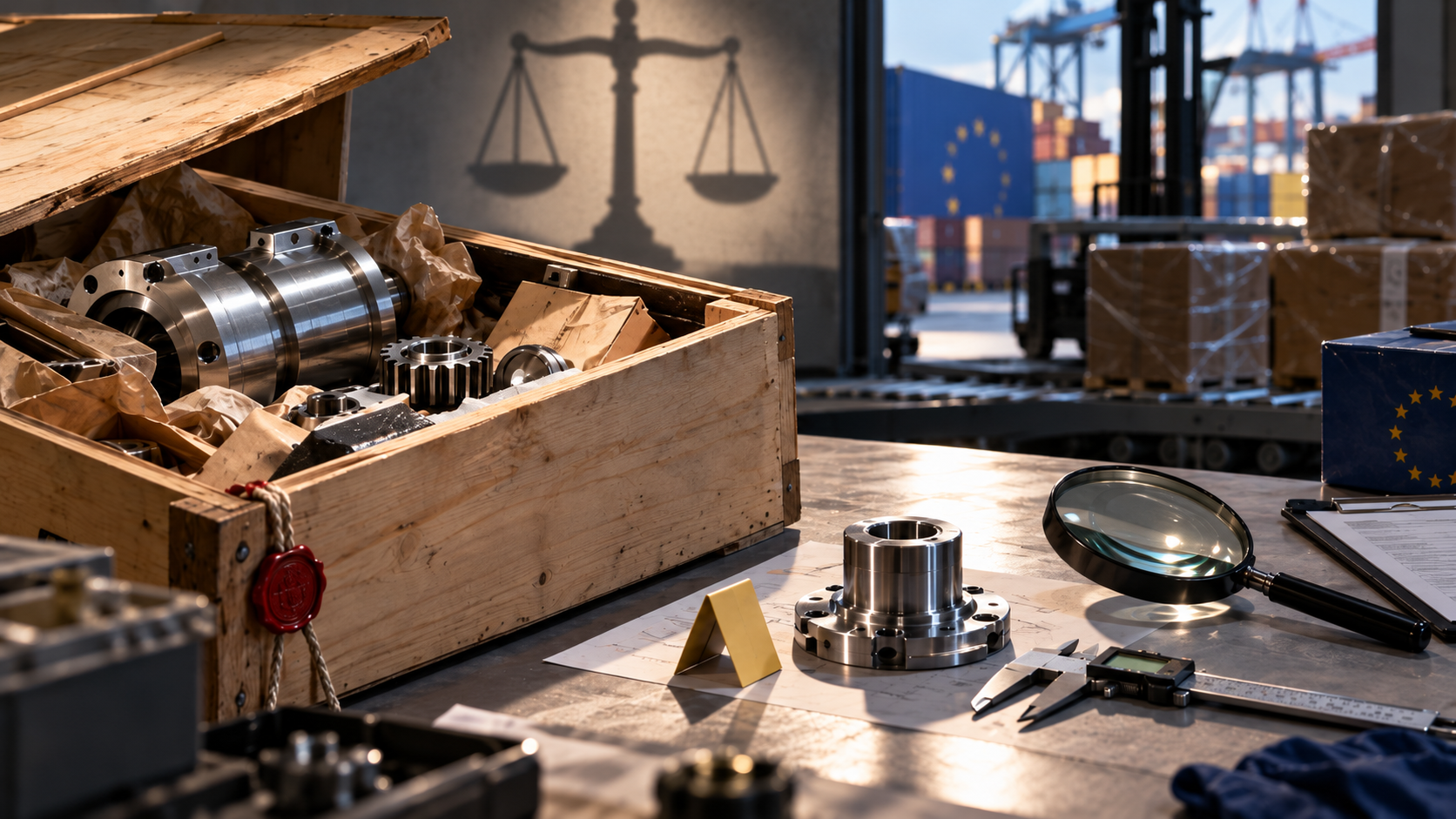
Product Liability 2026: What Changes for Manufacturers, Importers and Distributors
New EU rules on defective products, components, international supply chains, evidence and supply contracts
Updated: September 2026
The European rules governing liability for damage caused by defective products are about to change significantly.
Directive (EU) 2024/2853 of the European Parliament and of the Council of 23 October 2024 replaces the framework established by Council Directive 85/374/EEC and adapts EU product liability rules to markets and supply chains that are fundamentally different from those of the 1980s.
The reform is not limited to software, digital products or artificial intelligence. Its scope is considerably broader and directly affects manufacturers, industrial companies, component manufacturers, importers, distributors and businesses purchasing products or components from foreign suppliers.
The key date is 9 December 2026. Member States must transpose the Directive by that date and the new regime applies to products placed on the market or put into service after 8 December 2026, i.e. from 9 December 2026 onwards. Products placed on the market or put into service before that date remain subject to the previous regime based on Directive 85/374/EEC.
A Corrigendum published in the Official Journal of the European Union, L 2026/90364, on 7 May 2026 expressly corrected Article 2(1): the original wording referred to products placed on the market or put into service “after 9 December 2026”, whereas the corrected text reads “after 8 December 2026”.
Transposition is also already under way in Italy. On 7 August 2026, the Italian Government submitted to Parliament Government Act No. 434 (Atto del Governo n. 434), containing the draft legislative decree implementing Directive (EU) 2024/2853 on liability for defective products. As at the date of this update, the final Italian implementing legislation has not yet entered into force.
For businesses, this is therefore not an issue to postpone until the end of the year. This is the time to examine how the supply chain is structured, who is responsible for components, what purchase and supply contracts provide, what records are retained, and how defects, claims and product recalls are managed.
1) Why the EU product liability regime is changing
The previous European product liability regime dated back to 1985.
Since then, both products themselves and the supply chains through which they are designed, manufactured and marketed have changed substantially.
A company may design a product in Italy, purchase components in several countries, outsource manufacturing processes to non-EU suppliers, assemble the product elsewhere and market it through an international network of importers and distributors.
A single product may also depend on dozens or hundreds of components supplied by different businesses and, increasingly, may incorporate digital elements that affect its operation and safety.
The new Directive retains the fundamental principle of liability for damage caused by a defective product, but makes significant changes in several areas. It updates the definition of a product, clarifies which economic operators may be held liable, addresses supply chains involving non-EU manufacturers, gives specific relevance to components, regulates substantial modifications made after a product has been placed on the market, introduces new rules on disclosure of evidence and rebuttable presumptions, and takes account of digital elements and cybersecurity requirements relevant to product safety.
The reform therefore concerns product liability as a whole, rather than merely the technology sector.
2) When is a product defective?
Safety remains the central test.
Under Article 7 of the Directive, a product is considered defective where it does not provide the safety that a person is entitled to expect or that is required under Union or national law.
The assessment is not limited to whether there is a physical manufacturing defect.
All relevant circumstances must be taken into account, including the presentation and characteristics of the product, its design and technical features, instructions for assembly, installation, use and maintenance, reasonably foreseeable use, interaction with other products and the applicable product safety requirements.
For manufacturers and industrial businesses, this means that technical specifications, instructions, warnings, testing, inspections and quality-control procedures may become decisive in the event of a claim.
Risk management therefore does not begin when a damages claim is received. It begins much earlier, at the product design stage and when the supply chain responsible for producing the product is established.
3) Defective components: liability runs through the supply chain
One of the most significant issues for manufacturing companies concerns components.
Article 8 expressly provides that the manufacturer of a defective component may be liable where that component was integrated into, or interconnected with, a product within the manufacturer’s control and caused that product to be defective, without prejudice to the liability of the manufacturer of the finished product.
This is particularly relevant in industries involving complex products, including:
- automotive;
- industrial components;
- machinery;
- industrial plants and systems;
- equipment;
- products manufactured through multi-tier supply chains.
The issue immediately becomes a contractual one as well.
Where damage originates from a component purchased from a supplier, it must be possible to reconstruct precisely who established the technical specifications, who was required to perform the relevant tests, what inspections were agreed, what warranties were given, who must retain the supporting documentation, what notification obligations were imposed on the supplier and what rights of recourse are available.
A generic clause stating that “the component shall comply with applicable law” may prove insufficient once a defect has materialised and responsibility and economic consequences have to be allocated.
4) Non-EU manufacturers: the importer’s position becomes even more important
The new regime pays particular attention to international supply chains.
Where the manufacturer of a product or component is established outside the European Union, Article 8 identifies other economic operators established within the EU who may, subject to the conditions laid down in the Directive, be held liable.
Depending on the circumstances, these include:
- the importer of the defective product or component;
- the manufacturer’s authorised representative;
- where there is no importer established within the Union or authorised representative, the fulfilment service provider.
For an Italian company purchasing products or components from non-EU manufacturers, this is particularly significant.
Being “only the importer” does not necessarily place the company outside the chain of liability.
Before entering into or renewing a commercial relationship with a non-EU manufacturer, it therefore becomes even more important to assess the manufacturer’s reliability, quality standards, inspection procedures, available documentation, insurance coverage, contractual warranties, cooperation obligations in the event of a claim and the practical ability to exercise rights of recourse.
A carefully drafted right of recourse has limited value if the foreign counterparty is insolvent, does not retain the necessary technical documentation or makes contractual enforcement excessively difficult.
5) What about distributors? Liability is not automatic
The Directive does not automatically treat distributors as manufacturers.
There is, however, a specific situation in which a distributor may become liable.
Where an economic operator referred to in Article 8(1) and established in the Union cannot be identified, the injured person may request the distributor to identify such an economic operator or the distributor that supplied it with the product.
If the distributor fails to provide that identification within one month of receiving the request, the distributor may itself be held liable under the conditions laid down in the Directive. Similar rules may apply to certain providers of online platforms where the requirements specified by Article 8 are met.
This has an important practical consequence.
Supplier records, manufacturer identification, import documentation and commercial traceability are not merely administrative matters: they may become part of a company’s legal protection in the event of litigation.
6) A company that substantially modifies a product may be treated as its manufacturer
Another important area concerns modifications made after a product has been placed on the market or put into service.
The Directive defines a “substantial modification” as a modification made after the product has been placed on the market or put into service which is either considered substantial under relevant Union or national product safety rules or, where those rules establish no specific threshold, both:
- changes the product’s original performance, purpose or type in a way that was not foreseen in the manufacturer’s initial risk assessment; and
- changes the nature of the hazard, creates a new hazard or increases the level of risk.
A natural or legal person that substantially modifies a product outside the original manufacturer’s control and subsequently makes that product available on the market or puts it into service is considered to be a manufacturer of the modified product for the purposes of the Directive.
This issue can be particularly relevant where:
- machinery is extensively modified;
- industrial equipment is adapted to a new user’s requirements;
- components are replaced in a way that alters characteristics or risks;
- products are remanufactured or refurbished before being placed on the market again.
Before carrying out a significant alteration, the relevant question should therefore not only be:
“Is the modification technically feasible?”
but also:
“What legal position will the person making that modification assume?”
7) One of the most important changes: disclosure of evidence
The reform also makes significant changes to product liability litigation.
The general rule has not disappeared: the claimant is still required to prove the defectiveness of the product, the damage suffered and the causal link between that defectiveness and the damage. It would therefore be inaccurate to describe the Directive as introducing a general reversal of the burden of proof.
The Directive does, however, introduce mechanisms designed to deal with situations in which relevant evidence is held by the defendant.
Article 9 provides, subject to the conditions laid down in the Directive, for national courts to order the disclosure of relevant evidence in the defendant’s control where the claimant has presented facts and evidence sufficient to support the plausibility of the claim.
Disclosure must be limited to what is necessary and proportionate, and courts must also take account of the legitimate interests of all parties, including the protection of confidential information and trade secrets.
For businesses, this makes document management even more important.
In litigation, relevant evidence may include:
- technical specifications;
- testing and inspection reports;
- quality-control records;
- risk assessments;
- correspondence with suppliers;
- customer complaints;
- earlier reports of defects or incidents;
- corrective actions;
- documentation relating to individual components;
- decisions taken after a potential defect was identified.
The relevant question is therefore no longer merely:
“Did we carry out the necessary checks?”
but also:
“Will we be able, several years from now, to prove what we checked, when we checked it and what the results were?”
8) Defect and causation: the new rebuttable presumptions
The Directive also introduces specific rebuttable presumptions.
Under Article 10, defectiveness may be presumed in certain circumstances, including where:
- the defendant fails to disclose relevant evidence pursuant to Article 9;
- the claimant demonstrates that the product does not comply with mandatory product safety requirements intended to protect against the risk that materialised;
- the claimant demonstrates that the damage was caused by an obvious malfunction during reasonably foreseeable use or under ordinary circumstances.
The causal link between defectiveness and damage may also be presumed where the product has been established to be defective and the damage is of a kind typically consistent with the defect in question.
The Directive further addresses cases in which, because of technical or scientific complexity, a claimant faces excessive difficulties in proving defectiveness or causation. Even in those cases, however, the statutory conditions must be satisfied and the defendant retains the right to rebut the presumption.
For businesses, once again, technical records and traceability may become essential elements of the defence.o
9) What damage is covered? The distinction from B2B commercial claims
The Directive protects natural persons who suffer damage caused by defective products. It is not a general regime for every type of economic or commercial loss suffered by a business.
Subject to the conditions laid down in Article 6, compensable damage includes:
- death or personal injury, including medically recognised damage to psychological health;
- damage to, or destruction of, property, subject to the exclusions specified in the Directive;
- destruction or corruption of data that are not used for professional purposes.
Among the exclusions is damage to property used exclusively for professional purposes. Destruction or corruption of professional-use data is likewise outside this specific product liability regime.
This does not mean that businesses are left without remedies.
In B2B relationships, depending on the circumstances and the governing law, claims may still arise under contractual liability, warranties for defects or non-conformity, damages provisions, contractual indemnities, rights of recourse and other national liability regimes.
The distinction is important:
a product liability claim by an injured person and the subsequent allocation of responsibility between the manufacturer and its supplier are not necessarily the same legal dispute.
10) Supply contracts: why the reform also concerns procurement and legal departments
The new regime cannot be managed simply by inserting a clause stating:
“The supplier shall be liable for any defect in the product.”
Article 15 provides that liability under the Directive may not be limited or excluded vis-à-vis the injured person by a contractual provision.
This does not make supply contracts less important. Quite the opposite.
Contracts remain essential for regulating the internal allocation of risk between manufacturers, suppliers, importers and distributors, including warranties, cooperation duties, insurance arrangements and rights of recourse.
For this reason, at least the following areas deserve specific attention.
Technical specifications
The contract should clearly define characteristics, performance levels, tolerances, technical standards, safety requirements and required certifications.
Testing and inspections
The agreement should establish who is responsible for carrying out testing, which procedures apply, who retains the reports and what legal effect acceptance of the supply has.
Traceability
Where necessary, it should be possible to trace a finished product back to its relevant component, production batch and supplier.
Notification obligations
The supplier should be required to notify the customer promptly of any relevant:
- defect;
- non-conformity;
- incident;
- significant complaint;
- recall;
- intervention by a competent authority.
Cooperation in the event of a claim
If a damages claim is made, the manufacturer or seller of the finished product must be able to obtain the necessary technical records and assistance from its supplier without delay.
Warranties, indemnities and recourse
Existing contractual provisions should be reviewed together with the governing law, limitation-of-liability clauses, liability caps and insurance arrangements.
Insurance
Policy limits, geographical scope, product categories, exclusions and component-related exposures should be consistent with the company’s actual role in the supply chain.
The contract cannot prevent the injured person from bringing a claim, but it can determine where the risk ultimately remains within the supply chain
When damage is caused by a defective product, two distinct levels must be considered.
As regards the injured person, liability imposed by law on economic operators cannot be neutralised by an internal contractual clause between companies in the supply chain.
As between the manufacturer, supplier, importer and distributor, however, the contract remains fundamental in regulating technical specifications, testing obligations, notification duties, warranties, cooperation, insurance, indemnities and rights of recourse.
It is often at this second level that subsequent commercial litigation arises after the initial product liability claim has been dealt with.
11) Software and AI: an important development, but not the centre of the reform
The Directive also modernises the definition of “product” by expressly including software. Article 4 defines products broadly and expressly includes software, alongside movable goods, electricity, digital manufacturing files and raw materials.
The recitals make clear that this can include operating systems, firmware, computer programs, applications and AI systems.
The Directive also contains a specific exclusion for free and open-source software developed or supplied outside the course of a commercial activity.
For manufacturing companies, however, this development is particularly relevant where software or digital systems affect the operation or safety of machinery, vehicles, industrial components, equipment or other products.
The Directive also requires relevant cybersecurity requirements connected with product safety to be taken into account when assessing defectiveness.
The broader message for most businesses is therefore:
product liability no longer concerns only what is physically manufactured inside the factory; it concerns the product as a whole and the different components on which its safety depends.
12) What companies should review before 9 December 2026
Not every company faces the same level of exposure. Manufacturers, importers and businesses operating international supply chains should nevertheless review at least seven areas.
1. Map the supply chain.
Identify the manufacturer of the finished product, manufacturers of critical components, non-EU operators and any additional tiers of subcontracting.
2. Review purchase and supply agreements.
Check whether technical specifications, testing obligations, warranties, notification duties, indemnities and rights of recourse are adequate.
3. Review traceability.
Ensure that finished products can, where necessary, be linked to the relevant component, batch and supplier.
4. Review document-retention procedures.
Testing reports, inspection records, certificates and relevant supplier communications should remain retrievable over time.
5. Establish procedures for defects and incidents.
Define who receives reports, who assesses risk, who contacts the supplier and who takes operational decisions.
6. Review agreements with non-EU suppliers.
Consider whether contractual remedies can actually be enforced, whether the counterparty is solvent and insured, which law governs the agreement and which court or dispute-resolution mechanism has jurisdiction.
7. Review insurance coverage.
Ensure that policies reflect the products actually marketed, the territories concerned and the company’s effective role in the supply chain.
13) Transposition in Italy is under way
Directive (EU) 2024/2853 must be transposed by Member States by 9 December 2026.
In Italy, the legislative authority to implement the Directive is contained in Law No. 36 of 17 March 2026, formally entitled Delega al Governo per il recepimento delle direttive europee e l’attuazione di altri atti dell’Unione europea – Legge di delegazione europea 2025. It was published in the Italian Official Gazette No. 70 of 25 March 2026 and entered into force on 9 April 2026.
On 7 August 2026, the Italian Government submitted to Parliament Government Act No. 434 (Atto del Governo n. 434), containing the draft legislative decree implementing Directive (EU) 2024/2853 on liability for defective products.
As at the date of this update, the legislative process has not yet been completed.
It is therefore important to distinguish between:
- the rules already contained in Directive (EU) 2024/2853;
- the provisions contained in the Italian draft legislative decree, which are not yet the definitive national rules;
- the final legislative decree that will ultimately be adopted and published.
This section should therefore be updated once the Italian transposition process has been completed.
How we can assist
For a business that manufactures, imports or purchases products and components on international markets, the new product liability regime is not merely an issue to address after damage has occurred.
It is above all a matter of contractual risk prevention and proper organisation of the supply chain.
Studio Legale Rosano assists Italian and foreign companies with:
- reviewing international sale and purchase agreements;
- drafting and reviewing general conditions of sale and purchase;
- contractual provisions concerning technical specifications, compliance and warranties;
- relationships with non-EU manufacturers and suppliers;
- drafting and reviewing indemnity and recourse provisions;
- handling disputes concerning defective products and supplies;
- negotiations with customers and suppliers following defects or non-conformities;
- prevention and management of domestic and international commercial litigation.
For many businesses, 9 December 2026 will not necessarily require changes to the product itself. It does, however, make it advisable to determine now whether contracts, records, internal procedures and supply-chain relationships are adequate for the new liability framework.
11/09/2026
