
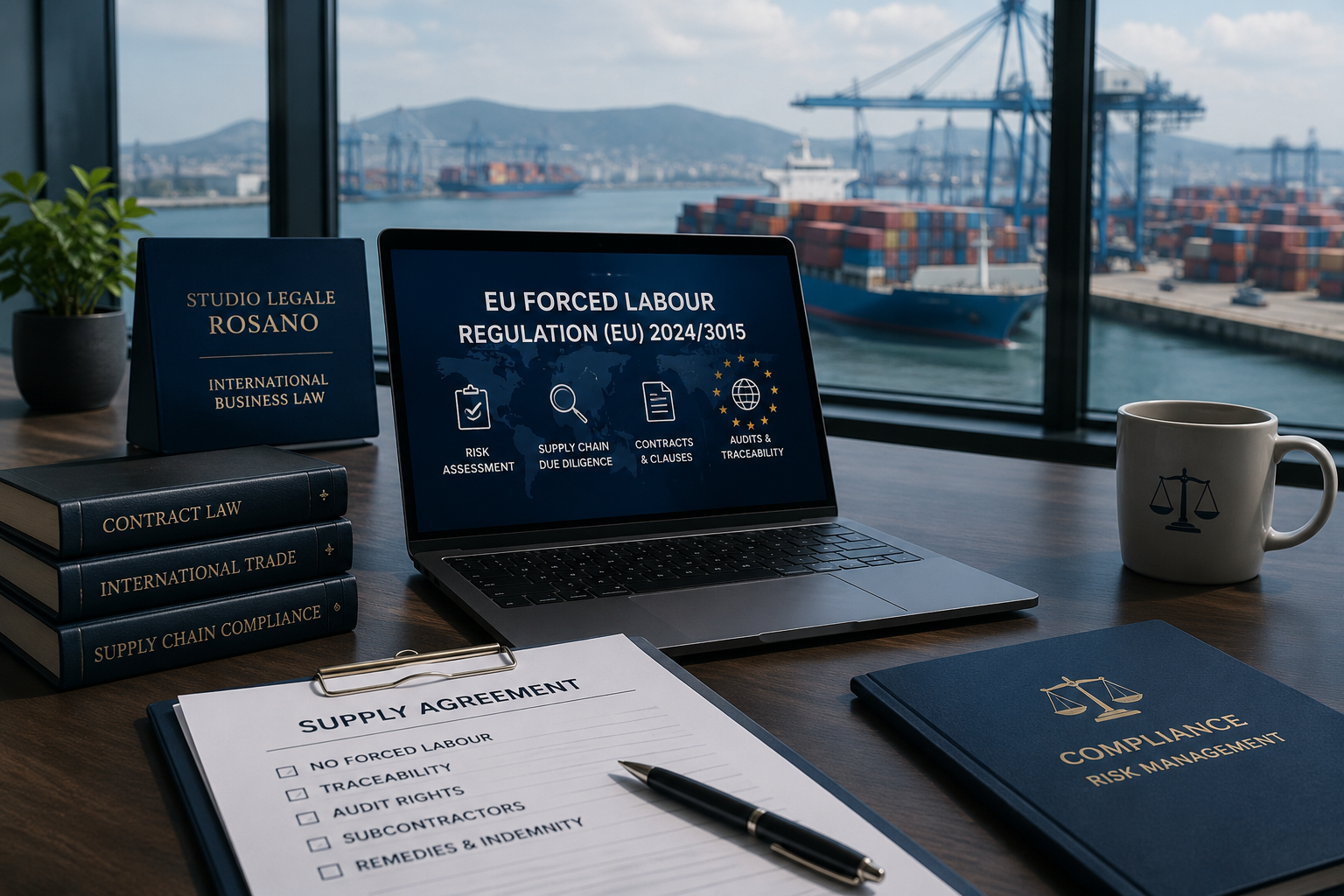
EU Forced Labour Regulation: what companies with international suppliers should do now
Contracts, audits, supply chains and protective clauses before the operational ban applies in 2027
Update: June 2026
Forced labour in international supply chains is no longer only an ethical or reputational issue. With Regulation (EU) 2024/3015, the European Union has introduced a prohibition on placing and making available on the EU market, as well as exporting from the EU, products made with forced labour.
The prohibition applies to products placed or made available on the Union market and to products exported from the Union, where they have been made with forced labour, regardless of the sector, origin or the point in the supply chain at which the relevant production phase takes place.
The rules will apply from 14 December 2027, but June 2026 is a key milestone: by 14 June 2026, the Commission is required to publish operational guidelines and the database on forced labour risks, tools intended to guide companies and authorities in assessing supply chain risks.
For businesses, the message is clear: waiting until 2027 means acting too late. Companies that import, export, distribute or purchase components from international supply chains should start reviewing suppliers, contractual clauses, audit rights, documentation and remediation procedures now.
1) What the EU Forced Labour Regulation prohibits
The Regulation prohibits placing or making available on the Union market products made with forced labour, as well as exporting them from the Union.
The logic is product-based: what matters is not only where the company is established, but the product and the supply chain through which it was made. The prohibition applies where forced labour has been used at any stage of production, manufacture, harvesting or extraction, including working or processing related to the product.
The definition of forced labour is aligned with ILO Convention No. 29: all work or service which is exacted from any person under the menace of any penalty and for which that person has not offered himself or herself voluntarily.
In practice, forced labour can take different forms: direct coercion, retention of identity documents, threats, debt bondage, intimidation or other forms of control over the person.
In practical terms: the risk does not concern only the direct supplier. It may arise in raw materials, in a processing stage, with a subcontractor, in a component or in a high-risk geographical area.
2) Why the issue is urgent in 2026
The Regulation will apply from 14 December 2027, but several operational components are already being developed: the database, guidelines, competent authorities, reporting procedures and investigation criteria.
The database will not replace the company’s own risk assessment, but it will support the identification of geographical areas, products or product groups exposed to significant forced labour risks.
The commercial dimension is equally important. The United States, the European Union and the United Kingdom are converging towards stricter regimes against products linked to forced labour. In the United States, Section 307 of the Tariff Act allows goods suspected of being produced with forced labour to be blocked, while the Uyghur Forced Labor Prevention Act introduced a particularly stringent mechanism for specific areas and supply chains.
For an Italian company purchasing from non-EU suppliers, this means one thing: compliance is no longer merely ESG documentation. It may become a customs risk, a contractual risk and a commercial blockage risk.
3) Who is affected
The Regulation has a very broad scope. It concerns products of any type, including components, and applies regardless of sector, origin and whether the product is imported, manufactured in the EU, sold on the EU market or exported.
Particularly exposed businesses include:
- importers;
- distributors and retailers;
- manufacturing companies using non-EU components;
- groups with supply chains in Asia, Africa, Latin America or other risk areas;
- companies selling to international clients already subject to US or UK standards;
- companies participating in tenders, ESG audits or supply chain qualification processes.
The point is not whether the company is “large”. The point is how well it really knows its supply chain.
4) Where the risk arises
4.1 “Clean” direct supplier, opaque subcontracting
Many companies know the first tier of their supply chain, but not the subcontractors. Forced labour risk may sit at the second or third tier: raw materials, semi-finished products, outsourced processing, packaging, logistics or assembly.
4.2 Generic contractual clauses
Many contracts contain generic statements such as “the supplier complies with applicable law”. That is not enough.
In the event of an investigation, a blockage or a request from the end customer, specific obligations are needed: traceability, audits, access to documents, remedies, corrective action plans, suspension rights and termination rights.
4.3 Merely formal audits
A scheduled annual audit is not sufficient if it is not linked to country risk, sector risk, reports, the database, whistleblowing or targeted document requests.
The Regulation follows a risk-based approach, requiring reliable information and checks proportionate to the risk. The company must be ready to demonstrate that it has taken the issue seriously.
The intensity of checks should be proportionate to the risk: not all suppliers require the same level of verification, but critical suppliers or suppliers located in sensitive areas or sectors should be monitored with stronger tools.
4.4 No remediation plan
The issue is not only discovering a risk. The issue is knowing what to do:
- suspend orders?
- request a corrective action plan?
- replace the supplier?
- preserve evidence?
- inform customers or authorities?
Without an internal procedure, every decision is taken in emergency mode.
5) What authorities may decide
The Regulation provides for a structured enforcement model: where the suspected forced labour takes place outside the Union, the European Commission acts as the lead competent authority; where it takes place within the territory of a Member State, the national competent authority acts.
Where a violation is established, the authority may adopt decisions preventing the product from being placed or made available on the EU market, prohibiting its export, and imposing withdrawal or management measures for products already placed in the supply chain.
The Regulation also provides for the involvement of customs authorities in the enforcement of prohibitions.
For companies, the consequence is concrete: a supply chain issue may become blocked goods, contracts that cannot be performed, penalties, end-customer claims and reputational damage.
6) Supply contracts: the clauses that really matter
This is the most important part for procurement and legal departments. Compliance with the Regulation is not managed only through an internal policy: it must be embedded in contracts.
A) Specific representations and warranties
The supplier should represent not only generic compliance with the law, but the absence of forced labour throughout the relevant product supply chain, including raw materials, components, processing and critical subcontractors.
B) Traceability and documentation
Upon request, the supplier should provide documented information on:
- origin of components;
- production sites;
- relevant subcontractors;
- certifications;
- audits;
- HR procedures;
- internal controls.
C) Audit rights
The contract should provide for document-based audits and, in more sensitive cases, on-site audits or audits through independent third parties.
The audit should be capable of being triggered not only periodically, but also in the presence of red flags, reports, database indications or requests from customers or authorities.
D) Subcontractors
The supplier should undertake to ensure that equivalent obligations are complied with by relevant subcontractors.
Without a flow-down clause, the supply chain remains exposed.
E) Corrective action plans and remedies
The contract should distinguish between:
- suspected risk;
- documentary non-compliance;
- concrete evidence;
- established violation.
Depending on the level, the contract should trigger information obligations, corrective action plans, order suspension, supplier replacement, termination and indemnity.
F) Cooperation in the event of an investigation
If an authority or an end customer intervenes, the supplier must cooperate quickly: documents, statements, access to sites, clarifications and support in preparing the response.
G) Indemnity and allocation of costs
Who bears the costs of goods that are blocked, withdrawn, replaced, managed according to the authority’s instructions or otherwise not marketable?
If the contract does not say so, disputes are likely. A specific clause is needed on costs, damages, end-customer penalties, legal fees and logistics costs.
Practical box — What needs to change in supply contracts
In contracts with international suppliers, a generic compliance-with-law clause is not enough. It is advisable to provide for:
- obligation to ensure traceability of the relevant supply chain;
- specific representations on the absence of forced labour;
- documentation obligations on production sites, subcontractors and critical components;
- audit rights proportionate to the risk;
- flow-down obligations towards relevant subcontractors, to avoid the clause remaining limited to the first tier of the supply chain;
- obligation to cooperate in the event of requests from authorities, end customers or customs;
- graduated remedies: corrective action plan, order suspension, supplier replacement, termination, indemnity.
This is the key point for procurement and legal departments: forced labour risk is not managed only with an ESG policy, but with contracts, audits, evidence and remedies.
7) Operational checklist for importers and industrial groups
Within 30 days
- map suppliers, countries and product categories;
- identify risk areas and sectors;
- check whether contracts contain specific clauses on forced labour, audits, subcontractors and remedies;
- verify whether international customers already require stricter standards.
Within 60 days
- update general purchasing conditions and framework agreements;
- prepare a targeted supplier questionnaire;
- define red flags and escalation procedures;
- include audit and cooperation clauses.
Within 90 days
- build a supplier/product/country risk matrix;
- activate targeted audits on the most sensitive suppliers;
- define a replacement or dual-sourcing plan for critical suppliers;
- prepare a response protocol in case of a request from an authority, customer or customs.
8) Red flags not to ignore
Enhanced verification should be triggered by:
- supplier located in a high-risk geographical area;
- abnormally low price;
- lack of traceability on subcontractors;
- refusal to provide documents;
- extensive use of labour through intermediaries;
- audits that are always pre-announced and never independent;
- reports from NGOs, media, customers or authorities;
- product linked to raw materials or sectors known to be sensitive.
9) Why act now, even though the ban applies from 2027
Many companies postpone action because 2027 seems far away. That is a mistake. Updating contracts, mapping suppliers, obtaining documents and introducing audit rights takes time.
In addition, international customers, banks, investors and large groups are already asking for supply chain assurances.
The risk is not only a future sanction. It is losing a customer, failing a due diligence process, seeing a shipment blocked, being unable to demonstrate traceability or being unable to pass the costs of non-compliance back to the supplier.
How we can help
Studio Legale Rosano supports companies and industrial groups with:
- review of supply contracts and general purchasing conditions;
- clauses on forced labour, traceability, audits, subcontractors, remedies and indemnities;
- international contracts with non-EU suppliers;
- escalation procedures and document management;
- renegotiation strategies when the supplier refuses audits or disclosure.
A preventive review of supply contracts is often far less costly than managing a crisis when the product has already been blocked or the end customer has already challenged the supply chain.
01/07/2026

