In recent days the Strait of Hormuz has become a pressure point for global shipping: reduced transits, vessels waiting at anchorage, rerouting, higher insurance premiums and a fuel-supply shock affecting fleet operations.
According to public reporting, the United States and other states are considering protective measures for merchant traffic, potentially through an international coalition, subject to the evolution of the security situation. Meanwhile, the tension continues to compress flows and sustain energy price volatility.
For businesses, the issue is not merely geopolitical — it is primarily contractual. Unless companies act immediately on force majeure, hardship, Incoterms, insurance and evidence/documentation, the risk is a domino effect: liquidated damages and penalties, delay disputes, blocked payments under letters of credit, carrier/forwarder claims, and emergency renegotiations conducted under maximum pressure.
1) What is happening: the signals that matter (for anyone contracting internationally)
Three indicators explain why Hormuz is a “here and now” issue for international contracts:
Surcharges and fuel shock
Major carriers have introduced emergency bunker/fuel surcharges (and similar adjustments), linking them to disrupted fuel availability and elevated operating costs.
Carriers in crisis mode
Extraordinary measures are being reported: network stress, delayed port operations, difficult bunkering, and additional surcharges (including by multiple operators).
“Non-obvious” impacts on industrial supply chains
Market analyses point to disruption in inputs essential to fertilisers and basic industry (e.g., urea/ammonia/sulphur), with knock-on effects far beyond energy.
Practical note: surcharges can be imposed by carriers under their own terms and tariff frameworks. If your sales/logistics contracts do not allocate these costs clearly, they tend to become disputes.
2) Immediate impact on companies: timing, costs and “documentary risk”
In a maritime chokepoint crisis, international sales and logistics issues typically arrive in three waves:
A) Timing and delivery
loading/discharge delays, congestion, cancellations, rerouting;
higher demurrage and detention exposure (containers and equipment immobilised) and other standstill costs.
B) Extra costs (often arriving after the fact)
bunker/fuel surcharges and deviation/rerouting costs;
war risk premiums and stricter insurance conditions — in some cases becoming commercially unsustainable in price and operational requirements.
C) “Technical default” under trade finance
Where payments are secured (letters of credit LCs / standby letters of credit SBLCs) or where supply contracts are built around hard shipment dates, a delay can become a formal non-compliance unless handled promptly through notices and waivers. This is a classic trigger of international commercial disputes.
3) FORCE MAJEURE: when it truly works (and when it does not)
This is where disputes are either prevented — or litigated.
3.1 The golden rule
Force majeure is not a label. It works only when there is a real impediment making performance impossible or objectively prevented — not merely more expensive.
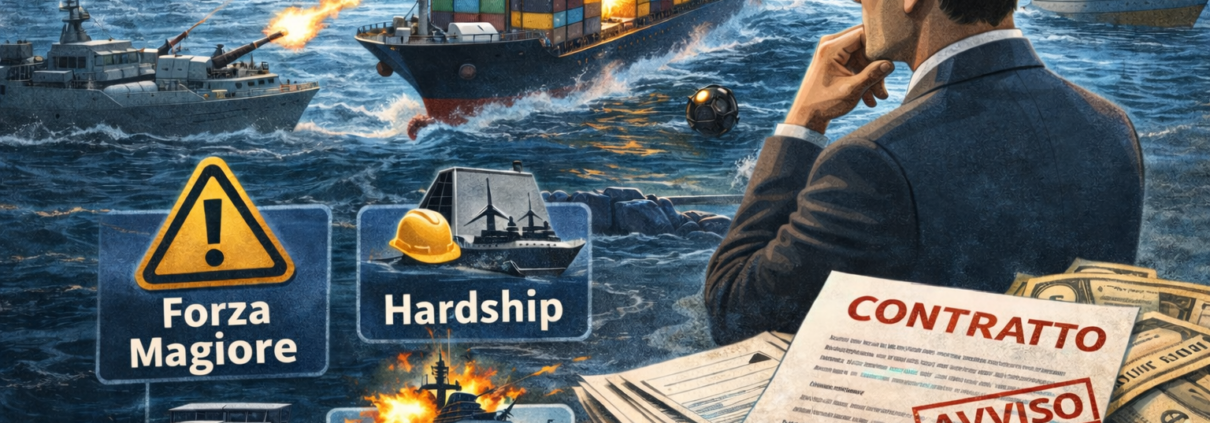
FORCE MAJEURE (impediment): route not reasonably navigable due to closure/attacks/threats; inability to obtain war-risk cover on commercially workable terms; governmental restrictions; carrier service suspension/cancellation that makes performance objectively impossible.
HARDSHIP (excessive onerousness): performance remains possible, but costs explode (fuel surcharge, war premium, rerouting). The proper tool is renegotiation/price adjustment, not force majeure.
The ICC 2020 Force Majeure and Hardship Clauses are a practical reference point because they structure conditions, notice, mitigation and consequences (suspension/termination) in a way that can be integrated into international supply and logistics contracts.
3.2 If the contract is governed by CISG: Article 79
Where the sale is governed by the CISG, the key provision is Article 79, which exempts a party from liability if it proves an impediment beyond its control that was not reasonably foreseeable and could not be avoided or overcome (or could only be overcome with unreasonable effort).
Crucial point: Article 79 typically affects liability for damages/penalties, but it does not automatically “cancel” the contract. Also, CISG practice places material weight on timely notice of the impediment: failing to notify can materially weaken the position.
3.3 What you must do to “hold” a force majeure position
Most clauses (and international practice) require:
causation: the event must be the cause of non-performance;
timely notice: often a condition precedent to relief;
mitigation: reasonable alternatives must be explored (rerouting, split shipments, alternative carriers);
evidence: carrier notices, broker/insurer communications, port advisories, mandated rerouting, governmental restrictions, etc.
In short: without documents, force majeure becomes opinion — and opinion rarely survives litigation/arbitration.
4) Incoterms: who pays vs who bears risk (not the same)
A very common source of disputes is the misunderstanding that “who pays the freight” equals “who bears transit risk”. It does not.
Under C-terms (e.g., CIP/CIF), risk typically transfers earlier than destination even where the seller pays carriage (and insurance under CIP/CIF).
Under D-terms (e.g., DDP), the seller remains exposed for longer. During a Hormuz-type crisis, DDP is often the most dangerous structure unless your contract contains robust price-adjustment and risk-allocation clauses.
Immediate consequence: if you are selling DDP or “all-in”, surcharges and delay costs can remain on the seller unless you have a coherent pass-through/hardship mechanism aligned with the risk allocation of the sale contract.
5) Insurance: standard cargo cover vs war risk
Insurance is decisive right now. A recurring misunderstanding is assuming that “all risks” cargo insurance automatically covers war/hostilities-type events. In practice, war risks are often excluded unless specifically endorsed, and policies may impose stricter operational conditions (prohibited areas, routing requirements, reporting obligations).
Best practice: obtain written confirmation from your broker/insurer on war-risk extensions, navigation conditions and premium changes — and align those confirmations with your contractual notices and mitigation plan.
6) What to do now: an operational checklist (48 hours / 7 days / 30 days)
Within 48 hours
Map exposure: in-transit shipments, open orders, sensitive routes, Incoterms, carriers/forwarders.
Collect evidence: surcharge notices, rerouting instructions, service suspensions, insurance notes.
Send a technical notice (not emotional): delay/impediment + request for instructions (and preserve proof of transmission).
Within 7 days
Qualify the remedy: force majeure vs hardship (do not confuse them).
Trade finance: for LC/SBLC flows, request waivers and adjust documentary timelines to avoid technical default.
Insurance: obtain written war-risk confirmations and conditions.
Within 30 days
Restructure core contracts with three minimum building blocks:
surcharge pass-through (fuel/war-risk/deviation);
hardship with fast renegotiation procedure;
force majeure with notice, evidence, mitigation and termination threshold.
Scenario planning: second sourcing, buffer stock, alternative routes, split shipments.
7) Three “minimum clauses” that reduce disputes (conceptual drafts)
These are only conceptual frameworks. They must be aligned with governing law, Incoterms, your carrier/forwarder contracts and insurance coverage. The most frequent mistake is copy-pasting without coordination.
Force majeure (notice + proof + mitigation): event definition, causation, notice within X days, mitigation duty, suspension, termination after Y days (ICC 2020 model as a reference).
Hardship / price adjustment: cost increase threshold, renegotiation timeline, adjustment mechanism, orderly exit if renegotiation fails.
Surcharge pass-through: definition of admissible surcharges (EBS/war-risk/deviation), documentary proof (carrier notice), allocation aligned with Incoterms and the structure of the sale contract.
How Studio Legale Rosano can assist (practically)
We can act quickly on:
contract audits (Incoterms, force majeure, hardship, pass-through);
notices and renegotiations (timeline, documentation, strategy);
coordination with brokers/insurers (war-risk terms and conditions);
dispute prevention on delays, penalties, LC/SBLC issues and international supply contract claims.
If you have shipments in transit or “fixed-date” orders, a rapid 48-hour review of contracts, notices and insurance coverage can materially reduce dispute risk and protect margins.

 Studio Legale Rosano